Wataru's hospital
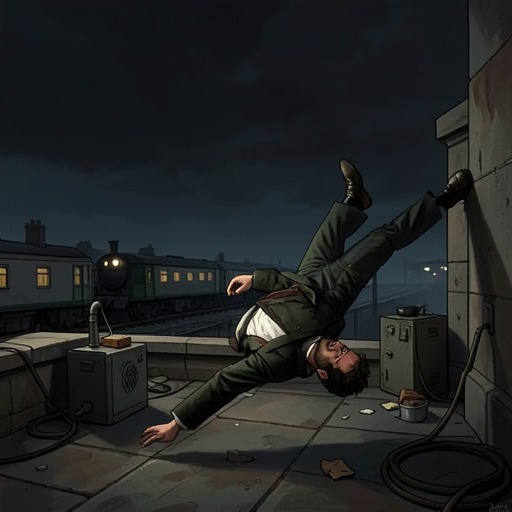
Bullet TrainWataru's hospital is an unnamed medical facility in Tokyo where six-year-old Wataru lies unconscious and unresponsive after falling from a department-store roof. It is both the place where Kimura's family waits beside the consequences of that fall and the distant point of danger the Prince uses to control Kimura aboard the train. The hospital itself remains largely out of view; its power in the story comes from what is happening to Wataru there and from how easily the Prince turns that separation into leverage.
Setting and Wataru's Condition
The hospital is introduced through Kimura's thoughts as he crosses the crowded Tokyo Station to board the Hayate. A child passing with a backpack recalls Wataru to him: the boy is in a hospital bed, unconscious and unable to respond. Kimura pictures his beautiful son lying there and feels his chest tighten. The recollection makes the hospital present in the station scene without moving the narrative to the ward; Kimura carries the image of his son into the journey and toward the person he holds responsible.
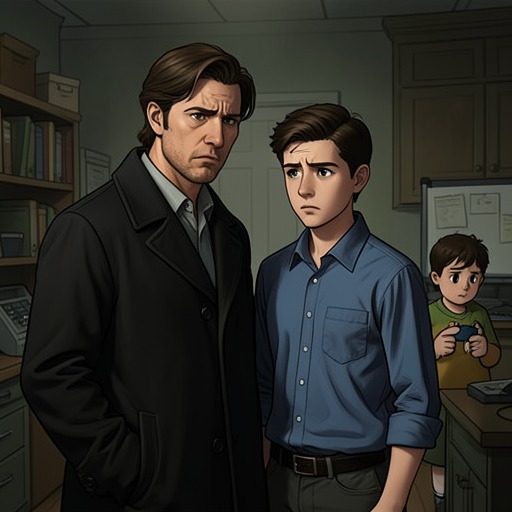
The boy's condition is conveyed through the family's response as well as through Kimura's image of the bed. Akiko Kimura, his mother, had wailed when she saw him, observing that he looked as if he were merely sleeping and might still hear what the family said. Her reaction gives the child's stillness a painful ambiguity: he appears familiar and present, yet cannot answer them. Kimura feels emptied from within at the thought. The hospital is therefore not simply a place of treatment; in this account it is where the family confronts the gap between Wataru's visible sleeping appearance and his unresponsive state.
Kimura's Connection to the Hospital
For Kimura, the hospital is bound to the cause of his journey. He believes the person who pushed Wataru from a department-store roof must pay, and his grief hardens into rage as he thinks of his son. At Tokyo Station he reminds himself that he has quit drinking, can walk straight, and has steady hands. Those details place his attempt at sobriety alongside his plan for vengeance: he means to act deliberately, even while the image of Wataru's condition remains the emotional force driving him toward the train.
The hospital also gives Kimura's anger a vulnerable focus. His target can be confronted aboard the Hayate, but Wataru remains in Tokyo, physically separated from his father and unable to protect himself. The Prince recognizes that distance and turns it into a means of pressure. When he asks after Kimura's child and alludes to the rooftop fall, the threat brings the hospital directly into the train compartment's struggle. Kimura's concern is no longer only what the Prince may do to him; it is what might happen to the boy left behind.
The Prince's Threat
The Prince tells Kimura that a person is standing by near the hospital and could act if Kimura disobeys or if something happens to the Prince. He leaves the precise position deliberately uncertain, suggesting that the person might even be inside the hospital, but insists that the essential point is proximity: the threat can be carried out quickly. The hospital's location is not named, and the waiting person's identity is not supplied in these exchanges. What Kimura is given is a credible-sounding claim of access, designed to make the unseen threat feel immediate.
The Prince makes the danger specific by describing the life-support equipment connected to Wataru. He says the person waiting near the hospital formerly worked for a medical equipment company and could interfere with the machine. Kimura rejects the suggestion that such interference would be possible, but the Prince answers that they will not know until the person tries. The uncertainty does not reassure Kimura. It is the mechanism of the threat: the Prince does not need to prove that sabotage will succeed in order to make the risk to Wataru govern his father's choices.
Signals, Surveillance, and Stakes
The Prince sets out a signal system that makes the hospital's danger conditional on events aboard the train. He says he will call the waiting person and give the green light; a call from that person that rings more than ten times without an answer will count as a green light too, even if it comes outside the scheduled calls at each station. The possibility that a missed call might trigger action means that silence, delay, or an interruption in communication can be framed as permission to harm Wataru.
Kimura points out that the phone might lose service, and the Prince replies that antennas have been installed in train tunnels. He also warns that if Kimura tries anything, he could simply refuse to answer the waiting person's call. As an example, he describes getting off at Omiya, going to a movie, and turning off his phone for a couple of hours; by the time he emerged, he says, something terrible could have happened to Wataru's life-support machine. The named station and ordinary activity make the threat concrete without confirming that the Prince intends to carry out this particular scenario. The hospital becomes the endpoint of a remote-control arrangement in which the Prince claims power over both the signal and the time at which help might arrive.
Narrative Significance
Wataru's hospital is a largely unseen location whose importance grows through absence: Kimura cannot watch over his son while pursuing the Prince, and the Prince exploits that separation. The hospital bed first concentrates the family's grief in Kimura's memory; later, the equipment sustaining Wataru's life becomes the object of an announced threat. This shift changes the stakes of the confrontation from Kimura's personal safety to the safety of his child.
The place is never rendered as a detailed ward or identified by a proper name. Instead, the story makes it legible through a small number of stark facts: Wataru is unconscious, he is connected to life-support equipment, his family has seen him there, and the Prince claims to have someone close enough to interfere. That restricted view suits the hospital's role in the conflict. It is at once the site of Wataru's helplessness and a pressure point carried into the moving train, where a phone call or an unanswered ring is made to stand between the boy and danger.